01 Five system states
Most practical troubleshooting begins with one deceptively simple question: what is this system supposed to be in sync with — and what changed in the relationship?
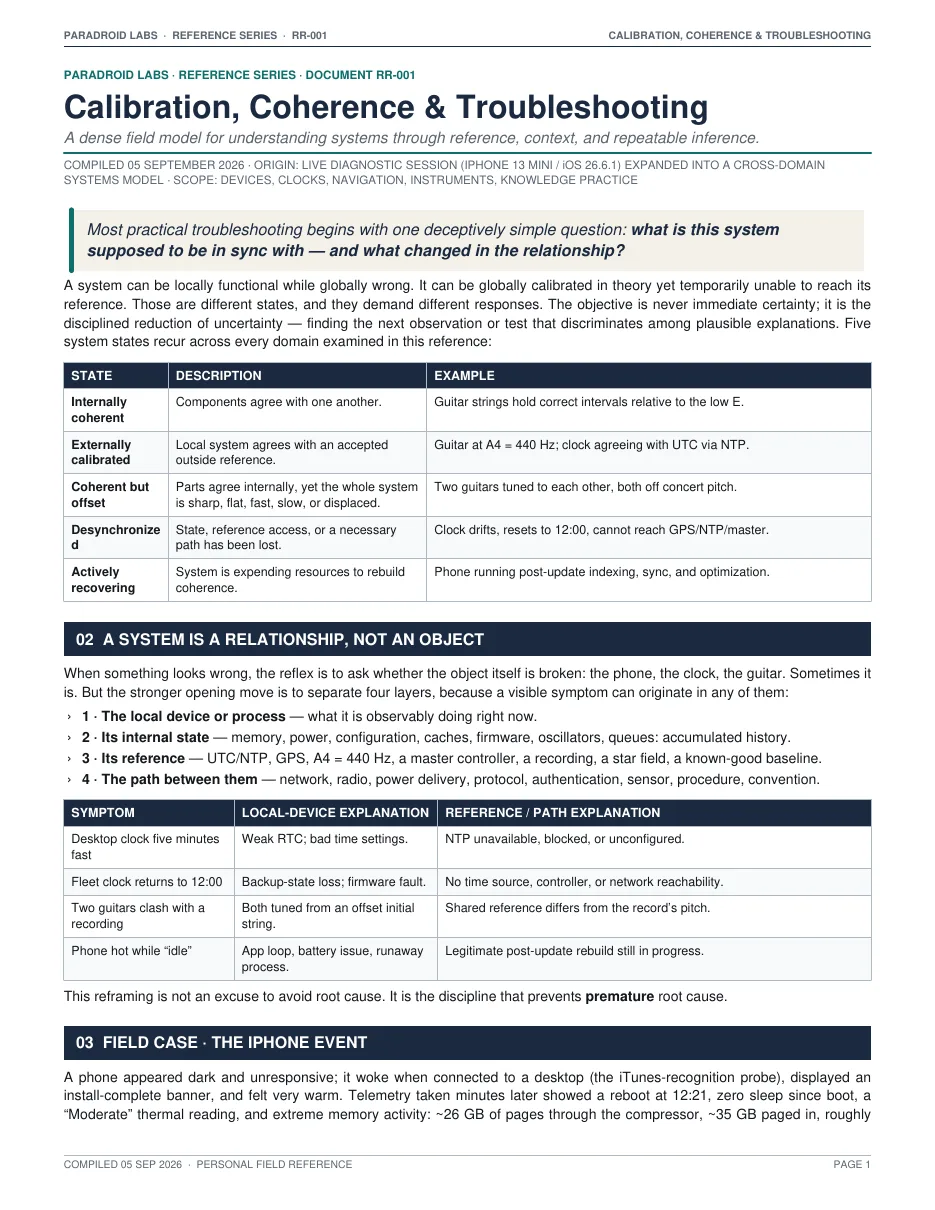
A system can be locally functional while globally wrong. It can be globally calibrated in theory yet temporarily unable to reach its reference. Those are different states, and they demand different responses. The objective is never immediate certainty; it is the disciplined reduction of uncertainty — finding the next observation or test that discriminates among plausible explanations. Five system states recur across every domain examined in this reference:
| State | Description | Example |
|---|---|---|
| Internally coherent | Components agree with one another. | Guitar strings hold correct intervals relative to the low E. |
| Externally calibrated | Local system agrees with an accepted outside reference. | Guitar at A4 = 440 Hz; clock agreeing with UTC via NTP. |
| Coherent but offset | Parts agree internally, yet the whole system is sharp, flat, fast, slow, or displaced. | Two guitars tuned to each other, both off concert pitch. |
| Desynchronized | State, reference access, or a necessary path has been lost. | Clock drifts, resets to 12:00, cannot reach GPS/NTP/master. |
| Actively recovering | System is expending resources to rebuild coherence. | Phone running post-update indexing, sync, and optimization. |
02 A system is a relationship, not an object
When something looks wrong, the reflex is to ask whether the object itself is broken: the phone, the clock, the guitar. Sometimes it is. But the stronger opening move is to separate four layers, because a visible symptom can originate in any of them:
- The local device or process — what it is observably doing right now.
- Its internal state — memory, power, configuration, caches, firmware, oscillators, queues: accumulated history.
- Its reference — UTC/NTP, GPS, A4 = 440 Hz, a master controller, a recording, a star field, a known-good baseline.
- The path between them — network, radio, power delivery, protocol, authentication, sensor, procedure, convention.
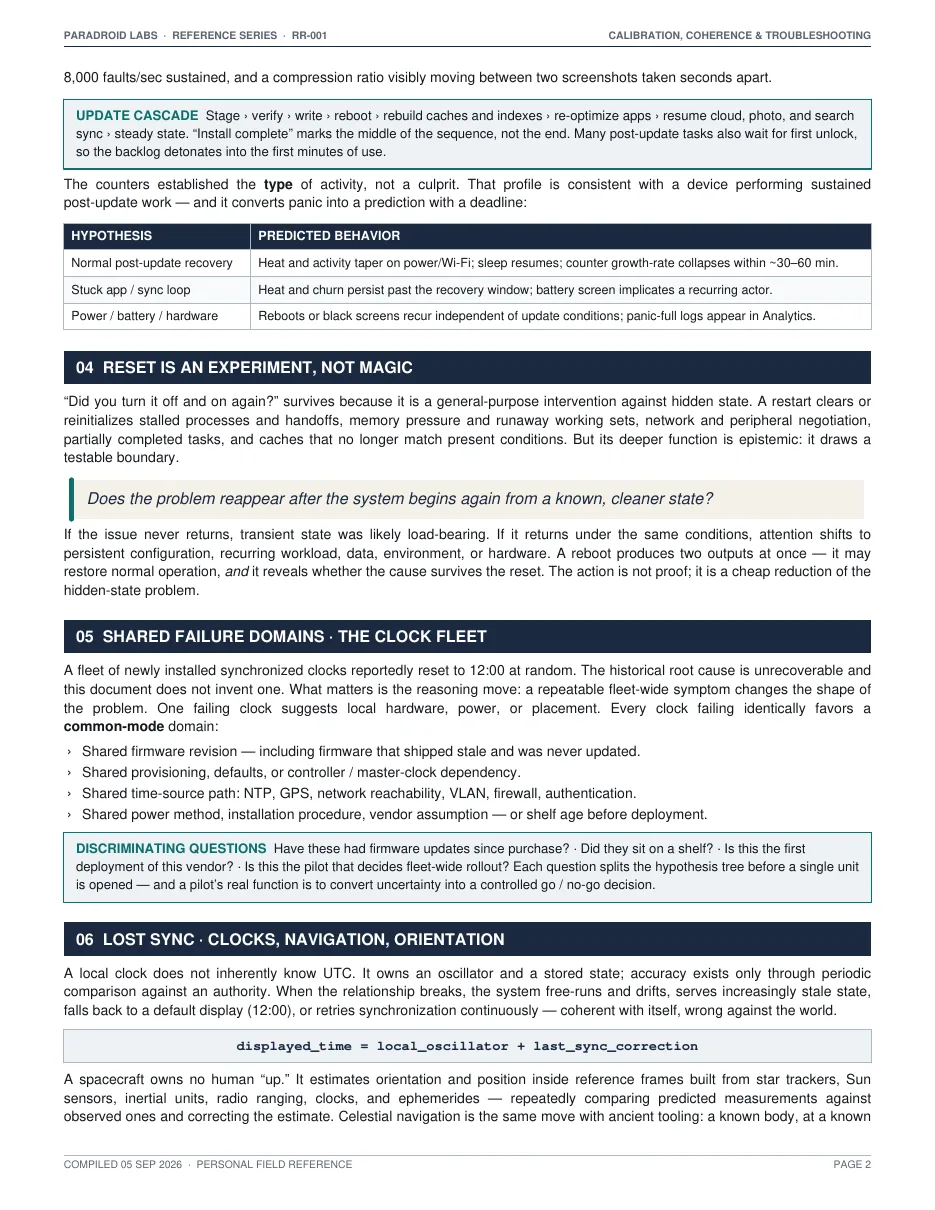
| Symptom | Local-device explanation | Reference / path explanation |
|---|---|---|
| Desktop clock five minutes fast | Weak RTC; bad time settings. | NTP unavailable, blocked, or unconfigured. |
| Fleet clock returns to 12:00 | Backup-state loss; firmware fault. | No time source, controller, or network reachability. |
| Two guitars clash with a recording | Both tuned from an offset initial string. | Shared reference differs from the record’s pitch. |
| Phone hot while “idle” | App loop, battery issue, runaway process. | Legitimate post-update rebuild still in progress. |
This reframing is not an excuse to avoid root cause. It is the discipline that prevents premature root cause.
03 Field case · The iPhone event
A phone appeared dark and unresponsive; it woke when connected to a desktop (the iTunes-recognition probe), displayed an install-complete banner, and felt very warm. Telemetry taken minutes later showed a reboot at 12:21, zero sleep since boot, a “Moderate” thermal reading, and extreme memory activity: ~26 GB of pages through the compressor, ~35 GB paged in, roughly 8,000 faults/sec sustained, and a compression ratio visibly moving between two screenshots taken seconds apart.
Update cascade. Stage › verify › write › reboot › rebuild caches and indexes › re-optimize apps › resume cloud, photo, and search sync › steady state. “Install complete” marks the middle of the sequence, not the end. Many post-update tasks also wait for first unlock, so the backlog detonates into the first minutes of use.
The counters established the type of activity, not a culprit. That profile is consistent with a device performing sustained post-update work — and it converts panic into a prediction with a deadline:
| Hypothesis | Predicted behavior |
|---|---|
| Normal post-update recovery | Heat and activity taper on power/Wi-Fi; sleep resumes; counter growth-rate collapses within ~30–60 min. |
| Stuck app / sync loop | Heat and churn persist past the recovery window; battery screen implicates a recurring actor. |
| Power / battery / hardware | Reboots or black screens recur independent of update conditions; panic-full logs appear in Analytics. |
04 Reset is an experiment, not magic
“Did you turn it off and on again?” survives because it is a general-purpose intervention against hidden state. A restart clears or reinitializes stalled processes and handoffs, memory pressure and runaway working sets, network and peripheral negotiation, partially completed tasks, and caches that no longer match present conditions. But its deeper function is epistemic: it draws a testable boundary.
Does the problem reappear after the system begins again from a known, cleaner state?
If the issue never returns, transient state was likely load-bearing. If it returns under the same conditions, attention shifts to persistent configuration, recurring workload, data, environment, or hardware. A reboot produces two outputs at once — it may restore normal operation, and it reveals whether the cause survives the reset. The action is not proof; it is a cheap reduction of the hidden-state problem.
05 Shared failure domains · The clock fleet
A fleet of newly installed synchronized clocks reportedly reset to 12:00 at random. The historical root cause is unrecoverable and this document does not invent one. What matters is the reasoning move: a repeatable fleet-wide symptom changes the shape of the problem. One failing clock suggests local hardware, power, or placement. Every clock failing identically favors a common-mode domain:
- Shared firmware revision — including firmware that shipped stale and was never updated.
- Shared provisioning, defaults, or controller / master-clock dependency.
- Shared time-source path: NTP, GPS, network reachability, VLAN, firewall, authentication.
- Shared power method, installation procedure, vendor assumption — or shelf age before deployment.
Discriminating questions. Have these had firmware updates since purchase? · Did they sit on a shelf? · Is this the first deployment of this vendor? · Is this the pilot that decides fleet-wide rollout? Each question splits the hypothesis tree before a single unit is opened — and a pilot’s real function is to convert uncertainty into a controlled go / no-go decision.
06 Lost sync · Clocks, navigation, orientation
A local clock does not inherently know UTC. It owns an oscillator and a stored state; accuracy exists only through periodic comparison against an authority. When the relationship breaks, the system free-runs and drifts, serves increasingly stale state, falls back to a default display (12:00), or retries synchronization continuously — coherent with itself, wrong against the world.
displayed_time = local_oscillator + last_sync_correction
A spacecraft owns no human “up.” It estimates orientation and position inside reference frames built from star trackers, Sun sensors, inertial units, radio ranging, clocks, and ephemerides — repeatedly comparing predicted measurements against observed ones and correcting the estimate. Celestial navigation is the same move with ancient tooling: a known body, at a known time, observed from an unknown place, constrains the observer. Regularity becomes the instrument; deviation from prediction becomes information.
07 The guitar model · Local coherence vs global calibration
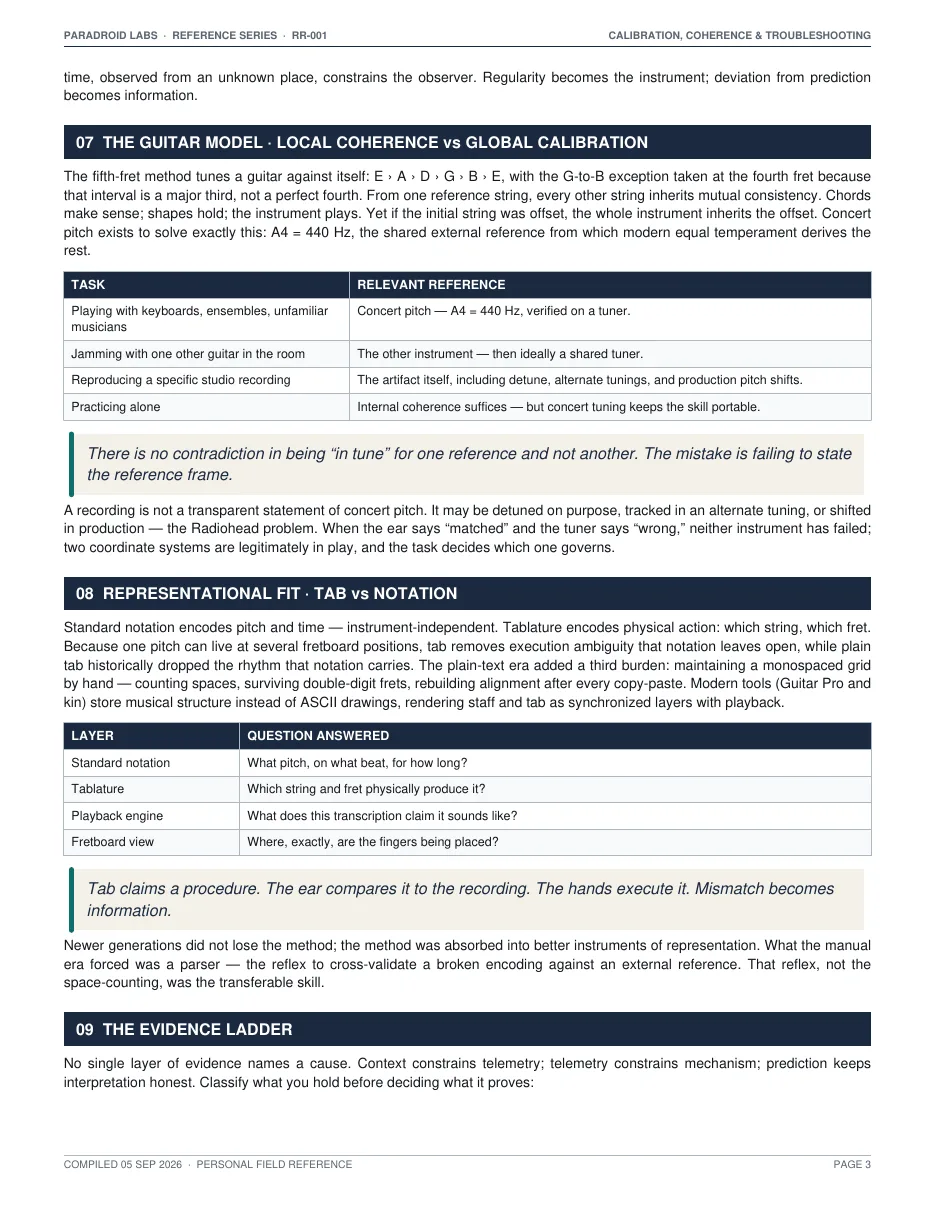
The fifth-fret method tunes a guitar against itself: E › A › D › G › B › E, with the G-to-B exception taken at the fourth fret because that interval is a major third, not a perfect fourth. From one reference string, every other string inherits mutual consistency. Chords make sense; shapes hold; the instrument plays. Yet if the initial string was offset, the whole instrument inherits the offset. Concert pitch exists to solve exactly this: A4 = 440 Hz, the shared external reference from which modern equal temperament derives the rest.
| Task | Relevant reference |
|---|---|
| Playing with keyboards, ensembles, unfamiliar musicians | Concert pitch — A4 = 440 Hz, verified on a tuner. |
| Jamming with one other guitar in the room | The other instrument — then ideally a shared tuner. |
| Reproducing a specific studio recording | The artifact itself, including detune, alternate tunings, and production pitch shifts. |
| Practicing alone | Internal coherence suffices — but concert tuning keeps the skill portable. |
There is no contradiction in being “in tune” for one reference and not another. The mistake is failing to state the reference frame.
A recording is not a transparent statement of concert pitch. It may be detuned on purpose, tracked in an alternate tuning, or shifted in production — the Radiohead problem. When the ear says “matched” and the tuner says “wrong,” neither instrument has failed; two coordinate systems are legitimately in play, and the task decides which one governs.
08 Representational fit · Tab vs notation
Standard notation encodes pitch and time — instrument-independent. Tablature encodes physical action: which string, which fret. Because one pitch can live at several fretboard positions, tab removes execution ambiguity that notation leaves open, while plain tab historically dropped the rhythm that notation carries. The plain-text era added a third burden: maintaining a monospaced grid by hand — counting spaces, surviving double-digit frets, rebuilding alignment after every copy-paste. Modern tools (Guitar Pro and kin) store musical structure instead of ASCII drawings, rendering staff and tab as synchronized layers with playback.
| Layer | Question answered |
|---|---|
| Standard notation | What pitch, on what beat, for how long? |
| Tablature | Which string and fret physically produce it? |
| Playback engine | What does this transcription claim it sounds like? |
| Fretboard view | Where, exactly, are the fingers being placed? |
Tab claims a procedure. The ear compares it to the recording. The hands execute it. Mismatch becomes information.
Newer generations did not lose the method; the method was absorbed into better instruments of representation. What the manual era forced was a parser — the reflex to cross-validate a broken encoding against an external reference. That reflex, not the space-counting, was the transferable skill.
09 The evidence ladder
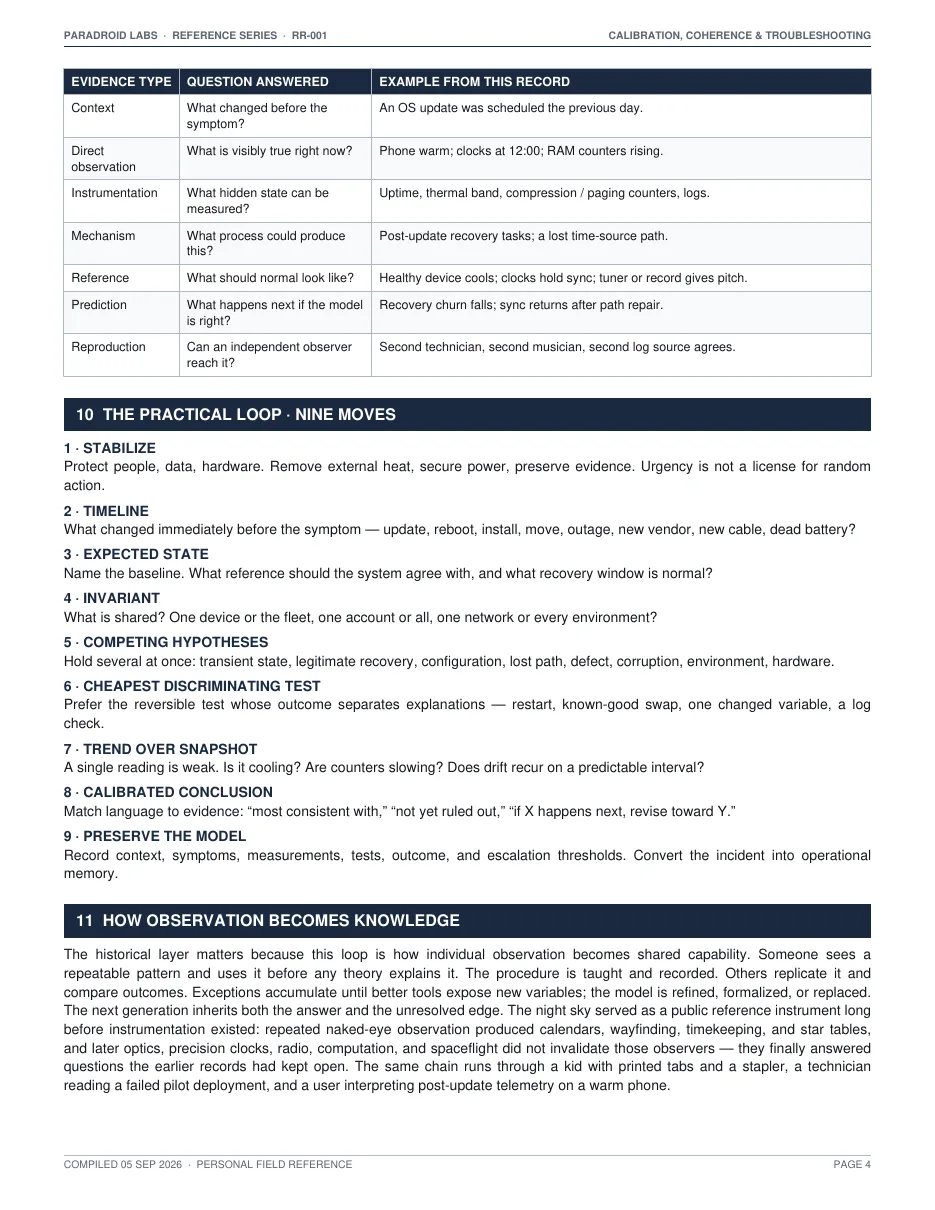
No single layer of evidence names a cause. Context constrains telemetry; telemetry constrains mechanism; prediction keeps interpretation honest. Classify what you hold before deciding what it proves:
| Evidence type | Question answered | Example from this record |
|---|---|---|
| Context | What changed before the symptom? | An OS update was scheduled the previous day. |
| Direct observation | What is visibly true right now? | Phone warm; clocks at 12:00; RAM counters rising. |
| Instrumentation | What hidden state can be measured? | Uptime, thermal band, compression / paging counters, logs. |
| Mechanism | What process could produce this? | Post-update recovery tasks; a lost time-source path. |
| Reference | What should normal look like? | Healthy device cools; clocks hold sync; tuner or record gives pitch. |
| Prediction | What happens next if the model is right? | Recovery churn falls; sync returns after path repair. |
| Reproduction | Can an independent observer reach it? | Second technician, second musician, second log source agrees. |
10 The practical loop · Nine moves
- Stabilize. Protect people, data, hardware. Remove external heat, secure power, preserve evidence. Urgency is not a license for random action.
- Timeline. What changed immediately before the symptom — update, reboot, install, move, outage, new vendor, new cable, dead battery?
- Expected state. Name the baseline. What reference should the system agree with, and what recovery window is normal?
- Invariant. What is shared? One device or the fleet, one account or all, one network or every environment?
- Competing hypotheses. Hold several at once: transient state, legitimate recovery, configuration, lost path, defect, corruption, environment, hardware.
- Cheapest discriminating test. Prefer the reversible test whose outcome separates explanations — restart, known-good swap, one changed variable, a log check.
- Trend over snapshot. A single reading is weak. Is it cooling? Are counters slowing? Does drift recur on a predictable interval?
- Calibrated conclusion. Match language to evidence: “most consistent with,” “not yet ruled out,” “if X happens next, revise toward Y.”
- Preserve the model. Record context, symptoms, measurements, tests, outcome, and escalation thresholds. Convert the incident into operational memory.
11 How observation becomes knowledge
The historical layer matters because this loop is how individual observation becomes shared capability. Someone sees a repeatable pattern and uses it before any theory explains it. The procedure is taught and recorded. Others replicate it and compare outcomes. Exceptions accumulate until better tools expose new variables; the model is refined, formalized, or replaced. The next generation inherits both the answer and the unresolved edge. The night sky served as a public reference instrument long before instrumentation existed: repeated naked-eye observation produced calendars, wayfinding, timekeeping, and star tables, and later optics, precision clocks, radio, computation, and spaceflight did not invalidate those observers — they finally answered questions the earlier records had kept open. The same chain runs through a kid with printed tabs and a stapler, a technician reading a failed pilot deployment, and a user interpreting post-update telemetry on a warm phone.
12 Closing principle
This system has an expected shape. Something differs from it. The difference may be a local fault, a lost reference, a broken path, a legitimate recovery process, or a wrong assumption about the baseline. Reduce the uncertainty: preserve context, find the reference, measure the present state, and choose the test whose outcome changes what you believe.
That is troubleshooting. It is also calibration, navigation, musicianship, scientific practice, and the preservation of useful knowledge across generations. One method, many instruments.
Quick reference. Symptom › context › telemetry › competing causes › discriminating test › trend › calibrated conclusion › recorded model. When a device is hot, the first thought is not “it is dying” — it is “it may be doing expensive, legitimate work; what changed, and is the trend resolving?”
About this reference
RR-001 is the first document in the Paradroid Labs reference series: the working method underneath the essays. It began as a live diagnostic session on an iPhone 13 mini after an iOS 26.6.1 update and was expanded into a cross-domain model. The fleet-clock case is recorded as reported; its historical root cause is unrecoverable, and the document does not invent one.
Companion: Calibration, Resolution & Instrumentality takes the next step. RR-001 asks whether a system agrees with its reference; the keystone adds how finely it can distinguish differences, and why more detail is not more truth.
The PDF edition is the layout original. This page carries the same wording with the tables rebuilt for the web.
Credit
Model credit pending. This is a demo edition while the site is still being built out; the drafting model was not tracked for this piece and has not been settled. The credit line will name the exact model, variant, and reasoning tier once it is confirmed.
Revision history
v1.0 · September 25, 2026 · First public web edition of the September 5, 2026 reference. Wording unchanged from the PDF.